

Most mid-market brokerages already run some version of freight tracking software. Whether it's McLeod or a patched-together internal tool, the core function is the same. It handles the majority of loads that move without incident.
That 80 percent is not where your margin is won or lost.
The real problem lives in the remaining 20 percent. The late pickups, missed appointments, no-shows, and billing disputes. Those are the loads that generate WISMO calls, burn out your ops team, and quietly erode profitability.
Here's the paradox. The better your track and trace automation gets, the more visible your problems become. Tracking does not reduce exceptions. It makes them impossible to ignore.
The Happy Path Is Already Solved
Most brokerages have already automated the basics. Carrier check calls, status updates, and ETA tracking are largely handled by existing systems.
That means the “happy path” is not your bottleneck anymore.
What happens next is predictable. As tracking improves, your system surfaces more exceptions with greater clarity. Loads that would have slipped through now show up as red flags.
The net effect is counterintuitive. Operational visibility increases faster than your ability to act on it.
That gap is where the real opportunity sits.
| Pros | Cons |
|---|---|
| High coverage on routine loads | No prioritization of what matters |
| Low marginal cost to track additional volume | Exceptions buried in queues |
| Strong baseline data generation | No guidance on what to do next |
Exceptions Are Where the Humans Still Live
Every exception follows a familiar pattern. A late pickup. A missed delivery window. A carrier that simply does not show up. An accessorial dispute that turns into a back-and-forth email chain.
None of these are hard to detect. They are hard to resolve.
Resolution requires context that does not live in your TMS. Customer-specific SOPs. Pricing rules. Informal agreements. Tribal knowledge built over years.
What Operators Actually Want
“Show me the issue loads, what matters right now, and what to do about it.”
Their tracking system could surface the problem. It could not recommend the next action.
That gap forces your most experienced brokers into exception handling all day. They are not booking freight. They are not growing accounts. They are firefighting.
That is your true capacity constraint.
The Logistics AI Roadmap That Emerges Naturally
Once you accept that exceptions are the bottleneck, the roadmap becomes obvious. It is not a big-bang platform. It is a layered system where each step produces the data required for the next.
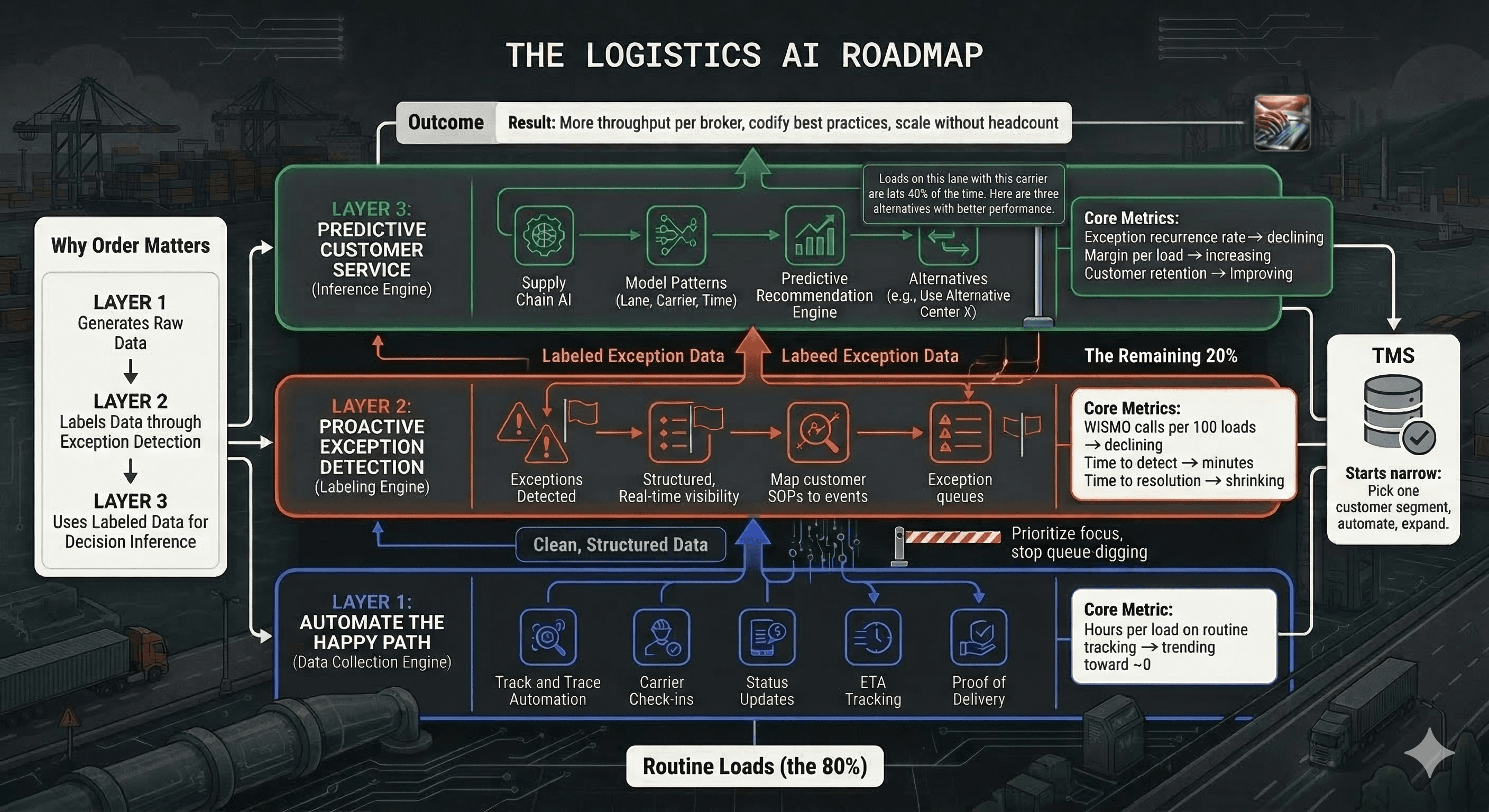
Layer 1: Automate the Happy Path (Track and Trace Automation)
Start with what is already mostly solved. Automate carrier check-ins, status updates, ETAs, and proof of delivery routing.
The goal is simple. Remove humans from routine tracking entirely.
Core metric
Hours per load on status updates → target: ~0 for non-exception loads
If your team is still spending meaningful time on routine tracking, nothing else will scale.
Layer 2: Proactive Exception Detection
Once the happy path is automated, your signal improves. Exceptions become clean, structured, and visible in real time.
Now you can do something useful with them.
You ingest customer SOPs and map them to load events. You define what “bad” looks like for each customer. You surface issue loads in a single view instead of burying them in a TMS queue.
This is where most firms stop. This is also where the real leverage begins when you apply AI workers.
Core metrics
- Customer calls per 100 loads → declining
- Mean time to detect exception → minutes, not hours
- Time to resolution → shrinking week over week
Pros:
- Clear prioritization of work
- Reduced customer escalations
- Faster reaction time
Cons:
- Requires SOP cleanup and standardization
- Forces uncomfortable visibility into operational gaps
- Still largely reactive
Layer 3: Predictive Customer Service and Pattern Learning (Supply Chain AI)
Exceptions are not random. They cluster around specific lanes, carriers, customers, and times. You already know this, but now you can do something about it.
Once you have clean exception data, you can model those patterns.
This is where AI workers actually become useful. Not as a dashboard, but as a recommendation and resolution engine that never sleeps, never shows up late, and never quits.
Instead of saying, “This load is late,” the system says: “Loads on this lane with this carrier are late 40 percent of the time. Here are three alternatives with better performance.”
That is a different category of capability.
Core metrics
- Exception recurrence rate → declining quarter over quarter
- Margin per load → increasing
- Customer retention → improving on at-risk accounts
Pros:
- Prevents problems instead of reacting to them
- Compounds value over time as data improves
- Direct impact on margin and retention
Cons:
- Requires high-quality historical data
- Longer feedback loops
- Easy to overbuild before foundation is ready
Why the Order Matters
You cannot skip to prediction.
Layer 1 generates the raw data. Layer 2 labels that data through exception detection. Layer 3 uses that labeled data to make decisions.
In other words:
- Track and trace automation = data collection engine
- Exception detection = labeling engine
- Prediction = inference engine
Most brokerages try to buy all three at once under the banner of a “logistics AI platform.” This nearly always fails, and not because of the technology, but because of the lack of institutional awareness and ability to make use of and teach that system how to perform.
Without the underlying data pipeline and rules, what you actually get is just a dashboard with no signal.
What Changes for Your Team
The goal is not fewer brokers. It is more throughput per broker.
Today, experienced operators spend most of their time handling repeat exceptions. That is low-leverage work disguised as expertise.
In a well-structured system:
- Routine tracking disappears
- Repeat exceptions are handled automatically
- Humans focus only on novel or high-impact issues
That changes the shape of the job.
Ops managers stop managing queues of everything that moved. They manage a prioritized list of what is actually wrong.
There is a second-order effect. You are forced to codify your best practices.
Customer rules. Lane preferences. Carrier performance. All of it moves out of people's heads and into systems.
That is how you scale without adding headcount.
Starting Without Ripping and Replacing
No one is replacing their TMS with an AI feature, though most AI SaaS companies are eventually going to try to convince you to replace your TMS.
We know this is not really how success is achieved.
The AI layer sits alongside your existing system. It reads data, applies rules, and surfaces actions. Your TMS remains the system of record.
The smallest useful starting point is inherently narrow by definition.
Pick one customer segment. Automate carrier check-ins and status updates. Measure the hours saved per load. Expand from there.
At Intrinsic Labs, we typically see this play out in a short cycle. A focused two to three week sprint maps the workflow, identifies the highest ROI intervention, and produces a concrete build plan. No six-month discovery phase, and no over-priced platform rewrite. Just results.
The Metrics That Tell You It's Working
You only need three numbers to know if your logistics AI roadmap is real.
| Layer | Metric |
|---|---|
| Layer 1 | Hours per load on routine tracking → trending toward zero |
| Layer 2 | Customer calls per 100 loads → declining |
| Layer 3 | Exception recurrence rate → declining quarter over quarter |
If those three metrics are moving, everything else is an implementation detail. If they are not, you are still in the visibility phase, not the optimization phase.
The Real Shift
Hiring AI Workers to run your track and trace motion is not the end state. It is the foundation. It will expose what is actually broken in your operation, and done right, it should lead to you finding you want many more AI Workers.
The 3PLs that recognize this early will not just track loads better. They will handle more volume at better margins with the same team. They will protect margin on the hardest loads, and turn operational knowledge into a system instead of a dependency.
That is the real shift. It's already happening, and the best time to start was yesterday.